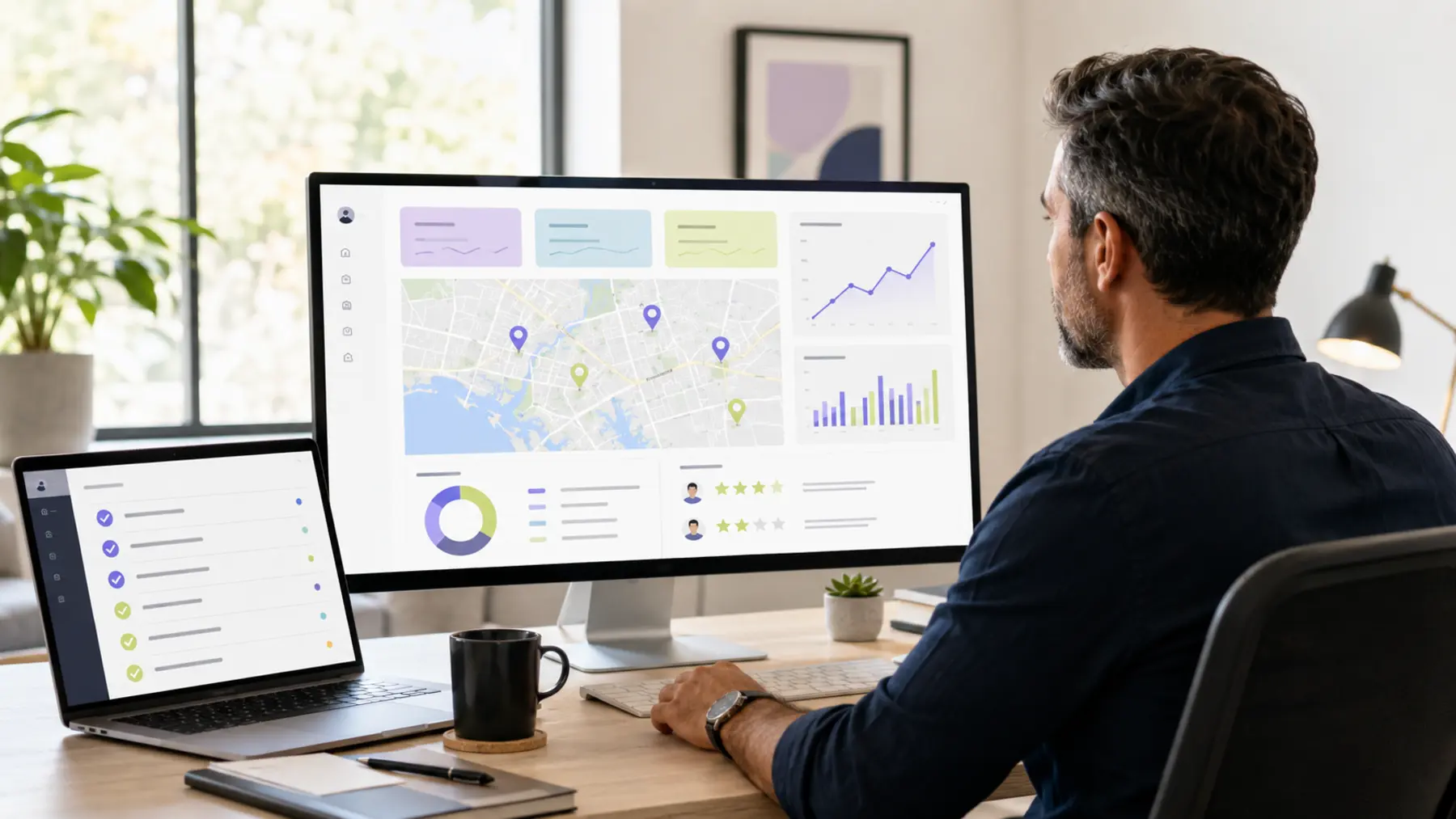
A local SEO report can contain hundreds of rankings, charts, and percentages while still failing to answer the question that matters most: Is local search producing better business opportunities?
The right local SEO metrics show how people discover your business, how they respond after finding it, and whether those interactions become qualified leads and revenue. Rankings are part of that story, but they are not the finish line.
If your campaign still needs a clear foundation, start with our step-by-step local SEO strategy. Once that system is in place, use the measurement framework below to evaluate its performance without getting distracted by vanity metrics.
Key Takeaways
Measure local SEO in layers: Visibility creates engagement, engagement creates conversions, and qualified conversions create revenue.
Never rely on one ranking: Local results change by searcher location, device, query, and time. Use geographic patterns instead of a single office-based search.
Separate branded and non-branded discovery: Brand searches show existing awareness. Non-branded searches are a better indicator of new customer discovery.
Track lead quality: More calls and forms do not help if the inquiries are outside your service area, unrelated to your services, or unlikely to close.
Connect reporting to decisions: Every monthly report should identify what changed, why it matters, and what the business should do next.
Start with the business
Build a measurement framework before opening a dashboard.
Tools should support the measurement plan, not define it. Start by documenting the services you want to sell, the markets you can realistically serve, the actions that count as conversions, and the information needed to qualify a lead.
Then organize the scorecard into four layers. This keeps the report from treating every metric as if it carries the same business value.
Visibility
Can nearby customers find the business for the services it wants to sell?
Engagement
Do those searchers click, call, request directions, or interact with the profile?
Conversion
Do visits and interactions become forms, appointments, and qualified conversations?
Business value
Do qualified opportunities turn into customers and profitable revenue?
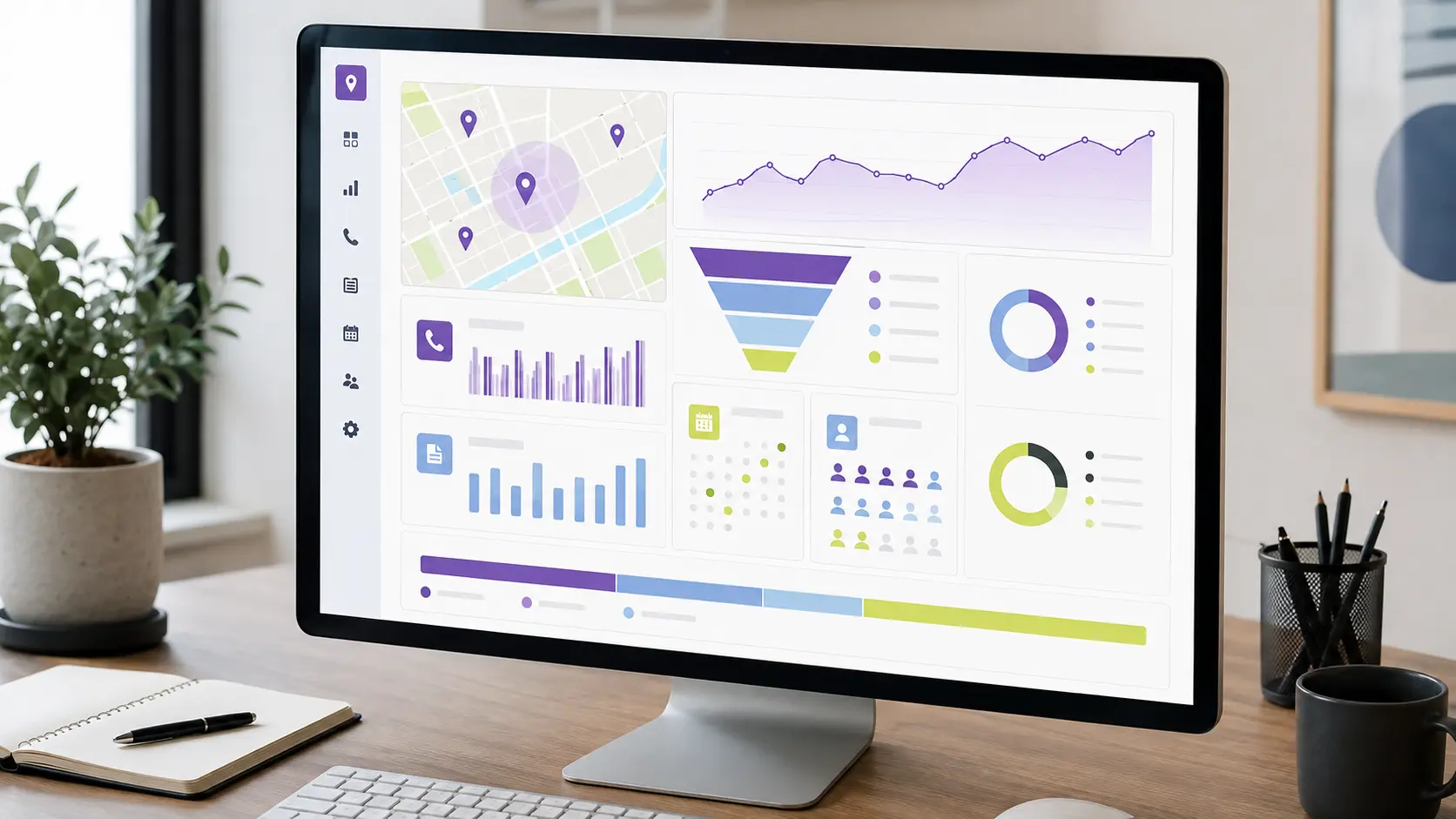
Metrics 1 through 4
Measure whether local customers can find you.
Visibility metrics diagnose how often the business appears and where coverage is weak. They help you identify opportunities, but they should always be evaluated beside engagement and conversion data.
If these metrics show a meaningful decline, use our process for diagnosing a local search ranking drop before making broad website or Business Profile changes.
Local pack visibility across the market
Local rankings are shaped by relevance, distance, and prominence. Because distance changes with the searcher, one ranking checked from one location is not representative of the entire market.
What to track
- Map visibility for a controlled group of priority service searches
- Coverage across a consistent geographic grid
- Average rank, top-three coverage, and areas with no visibility
- Changes by keyword group and physical location
Use the same grid points and keyword set each month. Changing the test conditions makes comparisons unreliable.
Organic search impressions
Search Console impressions show how often a link to your site appears in Google results. Rising impressions can indicate that Google is associating more pages with relevant searches, even before clicks increase.
Segment the data
Review impressions by query, page, device, and date. Separate branded searches from non-branded service searches so growing name recognition does not hide weak visibility for new-customer queries.
Non-branded organic clicks and click-through rate
Clicks from searches that do not include the company name show whether people are discovering the business while comparing options. Click-through rate helps identify pages that appear often but fail to earn attention.
Look for opportunity gaps
A page with relevant impressions and weak click-through rate may need a clearer title, stronger search-result messaging, or content that more directly matches the query. Compare similar search intent instead of treating sitewide CTR as one meaningful number.
Google Business Profile searches and views
Business Profile performance can show the search terms people used and how often the profile appeared on Google Search or Maps. This provides useful context for brand discovery and profile reach.
Read the trend carefully
Profile views are an exposure metric. A view does not mean someone visited the website, called, or became a customer. Use it as an early signal and compare it with the actions that follow.
Metrics 5 through 8
Measure what people do after finding the business.
Engagement metrics sit between visibility and conversion. They reveal whether the profile, search listing, and landing page give people enough confidence to take another step.
Website clicks from the Business Profile
Track how many people move from the profile to the website. Add consistent campaign parameters to the profile website URL so Google Analytics can distinguish that traffic from other organic visits.
Recommended tagging
Use a documented naming convention for source, medium, and campaign. Consistency matters more than clever naming because inconsistent tags fragment reports and make month-to-month analysis harder.
Calls from the profile and website
Calls are often the most valuable action for local service businesses. Track call-button activity from the Business Profile, phone-link clicks on the website, and call-tracking data when you need deeper attribution.
Do not count every call equally
Separate answered calls, missed calls, new leads, existing customers, spam, and wrong numbers when possible. Call quantity without call quality can create a false picture of campaign performance.
Direction requests
Direction requests can be meaningful for restaurants, retail businesses, medical offices, and companies where customers visit a physical location. They are less useful as a primary KPI for service-area businesses that travel to the customer.
Match the metric to the business model
Do not place direction requests at the top of every report simply because Google provides the number. Give it weight only when an in-person visit has real commercial value.
Review growth, rating, and response activity
Reviews provide social proof and can influence how confidently searchers choose a business. Track total reviews, average rating, review velocity, response rate, and recurring themes in customer feedback.
Focus on the customer experience
The goal is not to chase a perfect rating. Build a consistent, ethical request process and use review themes to improve operations, messaging, and service-page content.
Metrics 9 through 12
Measure whether attention becomes business value.
This is where local SEO reporting becomes useful to leadership. Conversion and revenue metrics show whether visibility is producing the types of customers the company actually wants.
Forms, bookings, and appointments
Track completed lead forms, booked appointments, text-message clicks, quote requests, and other meaningful actions. Use thank-you pages or confirmed events so form starts and button clicks are not mistaken for completed conversions.
Keep primary and secondary actions separate
A completed consultation request is usually more valuable than an email-link click. Create a clear hierarchy so reports do not combine every interaction into one inflated conversion total.
Conversion rate by landing page
Measure how often organic visitors complete a primary action after landing on each service or location page. This helps separate a visibility problem from a page-experience problem.
Use context before changing the page
A low conversion rate can come from weak intent, poor mobile usability, unclear messaging, limited trust signals, or an offer that does not fit the visitor. Review the queries and traffic source before redesigning the page.
Qualified leads and close rate
A qualified lead matches the services, geography, budget, timing, and customer profile the business can serve. Track which leads are qualified and how many become customers.
Close the gap between marketing and sales
Use a shared definition of lead quality. If the marketing report ends when a form arrives, it cannot tell you whether local SEO is attracting the right audience.
Revenue, customer value, and cost per acquisition
Connect closed customers to their original source whenever the data allows. Compare local SEO investment with new-customer revenue, gross profit, close rate, and customer lifetime value.
Use a realistic attribution model
A customer may discover the company in Maps, return through a branded search, and call days later. Record the earliest known source and the final conversion source instead of forcing every sale into a single-touch story.
Emerging measurement
Track AI visibility, but keep it in perspective.
AI-generated answers are changing how customers research local options. Monitor whether the business is mentioned, cited, or accurately described for important service questions across major answer platforms.
AI visibility is still less standardized than Search Console, Business Profile, analytics, and CRM data. Treat it as a directional metric instead of manufacturing a precise score that implies more certainty than the tools can support. Strong entity information, credible service content, third-party mentions, and local authority support both traditional search and GEO and AEO visibility.

Monthly scorecard
Build a local SEO report people can actually use.
A business owner should not need to interpret 40 charts to understand whether progress is being made. Lead with outcomes, explain the important changes, and move detailed diagnostics into a supporting section.
Business outcomes
Qualified leads, closed customers, revenue, close rate, and major changes in lead quality.
Conversion performance
Calls, forms, bookings, conversion rate, and the landing pages producing those actions.
Visibility and engagement
Map coverage, non-branded clicks, profile actions, and meaningful query or page trends.
What happens next
The findings, priorities, experiments, and decisions that should guide the next month.
Use comparisons that reflect the business.
Month-over-month reporting is useful for recent movement. Year-over-year reporting is often better for seasonal businesses. A rolling 90-day comparison can reduce the noise created by short-term ranking volatility.
Segment before drawing conclusions
- Branded versus non-branded searches
- Google Search versus Google Maps interactions
- Mobile versus desktop performance
- Service, location, and informational landing pages
- New leads versus existing-customer activity
- Qualified versus unqualified inquiries
Avoid bad conclusions
Six local SEO reporting mistakes.
Reporting one ranking
A result checked from one location cannot represent performance across an entire local market.
Combining brand and discovery
Growth in business-name searches can make acquisition performance look healthier than it is.
Counting every action equally
A qualified consultation and an email-link click should not carry the same reporting value.
Ignoring seasonality
Comparing a peak month with an off-season month can produce the wrong strategic conclusion.
Stopping at lead volume
More inquiries can hide declining quality, service-area mismatches, and poor close rates.
Reporting without decisions
A dashboard that does not lead to action is documentation, not strategic measurement.
Monthly review
Local SEO measurement checklist.
Confirm the services, markets, and conversions being measured
Keep the local rank-tracking grid and keyword set consistent
Separate branded and non-branded Search Console performance
Review Business Profile views, searches, and customer actions
Use consistent campaign parameters for profile website traffic
Track completed calls, forms, bookings, and appointments
Measure conversion rate by service and location landing page
Classify qualified leads, unqualified leads, and existing customers
Connect closed customers and revenue to source when possible
Compare month over month, year over year, and rolling 90-day trends
Document what changed and the likely reason
Choose the next action based on the weakest part of the customer path
Measure the customer path, not just the search result.
Local SEO success is not one number. It is a connected story that starts with visibility and ends with profitable customers. Track each layer, find where momentum stalls, and use the evidence to choose the next improvement.
For the execution plan behind these metrics, read our Local SEO Domination strategy. If you want help connecting search visibility to qualified leads, explore our local SEO services or start a conversation.